

The complex interplay of military might, intelligence capabilities, and regional influence defines the U.S. and Israel’s strategic position against Iran in 2026. This dynamic landscape, significantly shaped by recent escalations and strategic operations, demands a nuanced understanding beyond surface-level media narratives. For U.S. Military Veterans and defense policy analysts, grasping these dynamics is crucial for informed engagement in national security discussions.
This analysis leverages the Strategic Triangle Analysis Framework, a three-layer assessment model examining (1) Conventional Military Balance, (2) Intelligence and Cyber Domain Superiority, and (3) Proxy Network Dynamics. This framework reveals why the U.S.-Israel position is stronger than surface-level military comparisons suggest, by quantifying advantages in domains where Iran appears competitive on paper but faces critical operational disadvantages in practice.
Iran’s Military Capabilities and Regional Influence
Iran’s military, while having undergone modernization, has faced significant degradation from recent U.S. and Israeli operations. Its conventional forces, though extensive, primarily focus on asymmetric warfare and missile capabilities.
What is Iran’s current conventional military strength?
Iran’s conventional military forces have seen a substantial reduction in operational capacity following recent strikes. As of March 2026, missile launches have been reduced by 90% and one-way-attack (OWA) drone attacks by 95%. This degradation resulted from over 7,800 targets struck by U.S. forces by March 18, 2026.
- Iran maintains a vast arsenal of short-range missiles capable of reaching Gulf states.
- Its maritime capabilities include anti-ship ballistic missiles, explosive-laden drone boats, and swarming fast-attack craft.
- High-end acquisitions, such as components from Russia’s S-400 surface-to-air missile family and Rezonans-NE over-the-horizon radar, enhance air defense.
How extensive is Iran’s proxy network?
Iran’s proxy network extends across the Middle East, influencing conflicts in Lebanon, Iraq, Syria, and Yemen. However, this network is showing signs of degradation and increased independence among its factions.
- Hezbollah in Lebanon remains a primary, yet increasingly challenged, asset.
- Popular Mobilization Forces (PMF) factions in Iraq have fragmented, with over 170 attacks on U.S. military bases between October 2023 and February 2024.
- Houthi forces in Yemen face heightened diplomatic and financial vulnerability.
- Syrian Shiite militias primarily serve as logistical enablers rather than frontline combatants.
What is the status of Iran’s nuclear program in 2026?
As of March 14, 2026, the U.S. Intelligence Community (IC) assesses Iran’s nuclear enrichment program as obliterated following Operation Midnight Hammer. There have been no efforts to rebuild enrichment capability, with underground facilities buried and shuttered.
- Pre-2026, Iran’s enrichment progress had reduced the time needed to produce enough weapons-grade uranium for a first device to less than a week.
- The IAEA’s May 2025 assessment found no credible indications of an ongoing nuclear weapons program post-early 2000s, despite threshold capabilities.
- Iran’s pre-strike stockpile of 60% enriched uranium was 440.9 kg, sufficient for 7-8 weapons if further enriched.
How advanced are Iran’s ballistic missile and drone technologies?
Iran’s ballistic missile and drone technologies have advanced significantly, often through external assistance, but recent operations have severely curtailed their immediate threat. Russia is assessed as the most likely provider of fiber-optic drone capabilities to Iran, shared with proxies like Iraqi militias per ISW assessments.
- Iran’s “Look East” strategy has integrated Chinese precision tech for missile propellants and navigation.
- Russian contributions include combat-tested doctrine, high-end sensors, and real-time intelligence.
- The U.S. IC assesses Iran requires until 2035 to develop missiles capable of striking the U.S. homeland.
U.S. Military Posture and Strategic Assets in the Region
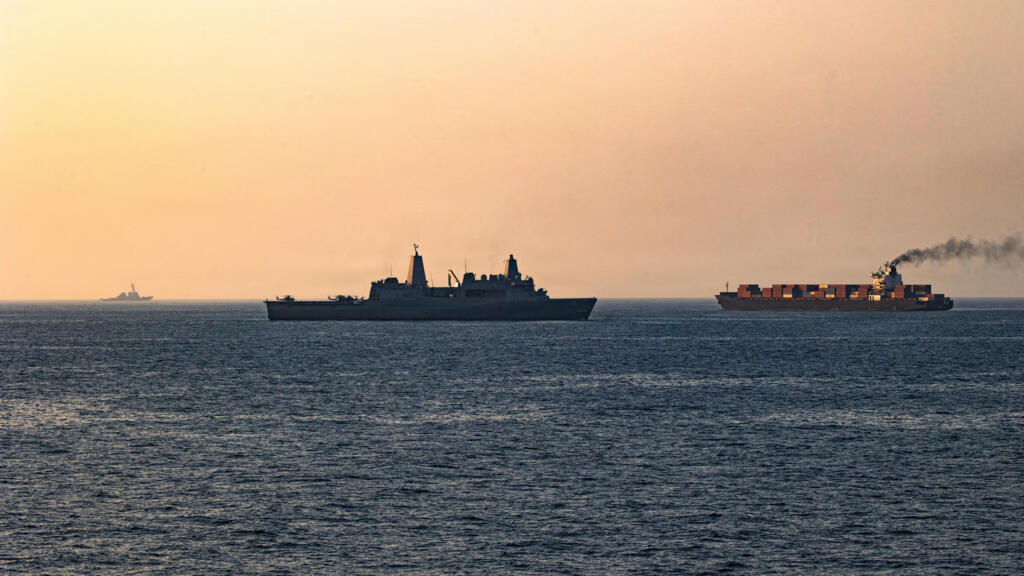
The U.S. maintains an unprecedented military concentration in the Middle East as of late April 2026, signaling a robust deterrence posture. This buildup represents (Business Insider).
- Naval Assets: Three aircraft carriers (USS Abraham Lincoln, USS Gerald R. Ford, and USS George H.W. Bush) and over 17 warships, including guided-missile destroyers.
- Air Assets: Over 100 fighter aircraft, including F/A-18E Super Hornets and F-35C Lightning IIs, deployed across the region.
- Personnel: Over 10,000 U.S. troops are enforcing the naval blockade of the Strait of Hormuz.
Where are key U.S. military installations and naval presences?
Key military installations and naval presences are strategically positioned throughout the Persian Gulf and broader Middle East to facilitate rapid strike operations and maintain regional stability. CENTCOM emphasizes that naval forces are “postured for rapid strike operations, indicating a deterrence posture rather than a transition to de-escalation” (Iran International).
- Naval forces are concentrated in the Arabian Sea, Red Sea, and Indian Ocean, ensuring robust maritime control.
- Air assets operate from various regional bases, providing extensive air superiority and reconnaissance capabilities.
- Mine clearance operations are underway, with two Avenger-class mine-hunters en route to CENTCOM’s area of operations (SOF News).
What ISR capabilities does the U.S. deploy?
The U.S. deploys advanced Intelligence, Surveillance, and Reconnaissance (ISR) capabilities to maintain situational awareness and support operations against Iranian threats. This includes a robust network of aerial and naval surveillance assets.
- High-altitude surveillance planes and rotary-wing aircraft provide persistent monitoring of Iranian activities.
- Satellite intelligence and signals intelligence (SIGINT) gather critical data on Iranian military movements and communications.
- Real-time data sharing with allies, particularly Israel, enhances collective threat assessment.
What are U.S. defense commitments to regional partners?
The U.S. maintains strong defense commitments to regional partners, aimed at deterring Iranian aggression and ensuring stability. General Michael “Erik” Kurilla noted that “a nuclear-armed Iran would change the Middle East overnight and forever, potentially setting off a regional arms race with catastrophic consequences,” framing the deployment within CENTCOM’s stated lines of effort to deter Iran (CENTCOM Posture Statement).
- The U.S. provides security assistance and military training to Gulf Cooperation Council (GCC) states.
- Joint exercises and interoperability initiatives strengthen collective defense capabilities.
- Commitments include supporting partners against Iranian proxy attacks and safeguarding critical infrastructure.
Israel’s Defense Strategy and Intelligence Operations
Israel’s defense strategy is characterized by high readiness, advanced missile defense, and sophisticated intelligence operations to counter Iranian threats directly and through proxies. The IDF has transitioned to immediate readiness mode, ordered by Chief of Staff Eyal Zamir on April 12.
How is the IDF structured and ready against Iranian threats?
The IDF’s force structure and readiness are intensely focused on multi-front escalation scenarios involving Iran and its allies. Its “Hoshen” multi-year plan (2026-2030) prioritizes multi-domain operations and technological advancements (The Defense Post).
- The IDF’s 2026 training schedule includes 4 General Staff exercises and 6 routine operations exercises.
- Post-war planning requires 60,000 reservists on duty at all times starting 2026, comprising over half of combined combat/support forces.
- The Galilee Division has been expanded to 2.5 times its pre-October 7 size, reinforcing northern defenses.
What are Israel’s missile defense capabilities?
Israel’s multi-layered missile defense system, including Iron Dome, David’s Sling, and Arrow systems, provides robust protection against a range of aerial threats. During the 2025 Twelve-Day War, the system achieved an nearly 900 strikes in the first 12 hours.
- Initial strikes degraded ~200 Iranian air defense systems, enabling airspace control.
- Hezbollah conducted 71 attacks on northern Israel/southern Lebanon in 24 hours (March 31-April 1), indicating continued proxy activity despite degradation.
- The strategic implication is a degraded, but not defeated, Iranian capability, with continued proxy threats.
The Intelligence Sharing Framework: How U.S. and Israel Coordinate
The intelligence sharing framework between the U.S. and Israel is robust, characterized by formal agreements and real-time operational coordination. This partnership is vital for maintaining a strategic advantage against Iran.
What are the formal and informal intelligence cooperation mechanisms?
Formal and informal intelligence cooperation mechanisms between the U.S. and Israel ensure a seamless flow of critical information. A secret memorandum expanded intelligence cooperation post-October 7, 2023, enhancing joint efforts in hostage recovery and counterterrorism (Jewish Virtual Library).
- The 2016 Memorandum of Understanding (MOU) provides Israel with $3.3 billion annually in foreign military funding and $500 million for cooperative missile defense.
- Informal channels facilitate rapid, often ad-hoc, sharing of urgent threat intelligence.
- Despite close ties, the U.S. briefly withheld some intelligence from Israel in 2024 over concerns about its use in Gaza (Al-Monitor).
How do they conduct real-time threat assessment and joint analysis?
Real-time threat assessment and joint analysis protocols enable both nations to respond swiftly to evolving Iranian aggression. This includes shared access to surveillance data and combined analytical efforts.
- Joint intelligence centers facilitate integrated analysis of Iranian military movements, nuclear developments, and proxy activities.
- U.S. drone surveillance, at times provided in real-time, supports Israeli operations, particularly for hostage recovery and Hamas tracking.
- Lessons from recent coordinated responses to Iranian aggression refine these protocols, ensuring continuous improvement.
What is the extent of technology sharing and cyber defense collaboration?
Technology sharing and cyber defense collaboration are critical components of the U.S.-Israel strategic partnership, extending to advanced military and intelligence technologies. This collaboration strengthens both nations’ defensive and offensive capabilities in the cyber domain.
- Cooperative missile defense programs, like the Arrow system, are prime examples of technology sharing.
- Joint cyber defense exercises and intelligence exchanges aim to counter Iranian cyber warfare capabilities.
- The U.S. IC monitors Iranian intent for cyber attacks on U.S. networks (DNI 2026 Annual Threat Assessment).
Discussions on nuclear deterrence are a critical aspect of U.S. and Israeli strategy, underpinning the importance of this intelligence framework.
| Capability Area | U.S. Strategic Assets | Israeli Strategic Assets | Operational Advantage |
|---|---|---|---|
| Long-range strike capability | Strategic bombers, carrier-based aircraft, long-range cruise missiles | F-35I Adir, Jericho ballistic missiles | U.S. provides global reach; Israel offers regional precision and proximity. |
| Naval power projection | Three aircraft carrier strike groups, extensive destroyer fleet | Submarine fleet, fast-attack craft, naval special forces | U.S. controls major waterways; Israel maintains coastal defense and covert naval ops. |
| Missile defense systems | Patriot, THAAD, Aegis Ballistic Missile Defense System | Iron Dome, David’s Sling, Arrow 2/3, Iron Beam | Layered defense protects against varied threats, from short-range rockets to ICBMs. |
| Intelligence gathering (HUMINT/SIGINT) | Vast global network, NSA, CIA, DIA | Mossad, Unit 8200 | Complementary human and signals intelligence, deep regional expertise. |
| Cyber warfare capabilities | U.S. Cyber Command, extensive offensive/defensive tools | Unit 8200, National Cyber Directorate | Combined efforts offer robust defense and potent offensive capabilities. |
| Regional force presence | CENTCOM deployments (10,000+ troops, 100+ aircraft, 17+ warships) | IDF ground, air, and naval forces on high alert | U.S. provides overwhelming force; Israel offers immediate, localized response. |

Critical Threat Scenarios and Response Options
The U.S. and Israel face several critical threat scenarios from Iran, requiring coordinated and flexible response options. These scenarios range from nuclear escalation to persistent proxy warfare and cyberattacks.
What are the response options for an Iranian nuclear breakout?
In the event of an Iranian nuclear breakout scenario, military response options would be immediate and severe, building on previous operations that obliterated enrichment capabilities. The U.S. IC continues to monitor for any early indicators of new leadership authorizing a nuclear weapons program (DNI 2026 Annual Threat Assessment).
- Preemptive strikes against any attempts to rebuild enrichment facilities, leveraging intelligence on Iran’s nuclear infrastructure.
- Targeted operations to disrupt weaponization efforts and delivery system integration.
- International sanctions and diplomatic pressure to isolate Iran and prevent proliferation.
How can regional escalation through proxy forces be countered?
Countering regional escalation through proxy forces requires a multi-faceted approach, combining military deterrence, intelligence operations, and support for regional partners. Iran’s proxy model is degrading due to military attrition, leadership losses, and logistical disruptions (Belfer Center).
- Persistent strikes against proxy infrastructure, command and control nodes, and weapons stockpiles.
- Support for host countries to counter proxy activities, including training and equipment for border forces.
- Targeting financial networks that sustain proxy groups, such as Hamas’s European charity operations that generated $10 million monthly prior to October 7, 2023.
What are the threats to critical infrastructure from cyber warfare?
Cyber warfare poses significant threats to critical infrastructure in both the U.S. and Israel, necessitating robust defense and offensive capabilities. Iran maintains intent for cyber attacks on U.S. networks.
- Advanced persistent threat (APT) groups linked to Iran regularly target government, military, and industrial systems.
- Collaboration on cyber defense strategies and sharing of threat intelligence are crucial to mitigating these risks.
- Deterrence through demonstrated offensive cyber capabilities discourages large-scale attacks.
What are the economic implications of a Strait of Hormuz closure?
A closure of the Strait of Hormuz would have severe global economic implications, disrupting oil and gas supplies and driving inflation. The strait, through which 20 percent of the world’s oil passes, remains severely disrupted as of late April 2026 (Manara Magazine).
- The U.S. Navy has initiated a blockade of the strait, with President Trump threatening to target Iran’s civilian energy infrastructure if interference continues (KTVZ News).
- Military planners are developing strategies to target Iran’s Strait of Hormuz defenses if the ceasefire fails (KTVZ News).
- Economic impacts include a global energy shock and potential for further escalation if Iran pressures Houthi allies to block the Bab el-Mandeb Strait.
What Veterans and Defense Communities Should Monitor
U.S. Veterans and defense communities play a vital role in understanding and influencing defense policy. Monitoring key indicators and engaging with informed resources is essential.
What are key indicators of escalation or de-escalation?
Monitoring key indicators provides insight into potential escalation or de-escalation in the U.S.-Israel-Iran strategic dynamic. These indicators include changes in military posture, diplomatic engagements, and proxy activity.
- Military Posture: Changes in U.S. force deployments, Israeli readiness levels, or Iran’s missile/drone activity.
- Diplomacy: Progress or breakdown in ceasefire negotiations, multilateral discussions, or sanctions enforcement.
- Proxy Actions: Intensification or reduction of attacks by Iranian-backed groups like Hezbollah or the Houthis.
How do policy changes affect force posture and the Veteran community?
Policy changes directly impact force posture and have significant implications for the Veteran community, from potential deployments to resource allocation for veteran support programs. Understanding geopolitical strategies in the Middle East, including past conflicts like Afghanistan, provides crucial context.
- Shifts in U.S. defense strategy may lead to changes in troop rotations, affecting military families and reservists.
- Budgetary decisions related to defense spending can influence veteran benefits, healthcare, and job opportunities.
- Veteran voices are crucial in shaping these policies, ensuring that the experiences of those who served are heard.
What resources help stay informed on Middle East security developments?
Staying informed on Middle East security developments requires reliable, analytical resources beyond mainstream headlines. Oscar Mike Radio offers in-depth discussions and expert analysis tailored for U.S. Veterans and defense professionals.
- Oscar Mike Radio provides podcasts and content featuring military experts and policy analysts, offering unique perspectives on complex security issues.
- Official reports from the Director of National Intelligence (DNI), CENTCOM, and the IAEA offer authoritative data.
- Think tanks like the Institute for the Study of War (ISW) and the Belfer Center provide detailed analysis and updates.
What is the role of Veteran voices in defense policy discussions?
Veteran voices are indispensable in defense policy discussions, bringing invaluable firsthand experience and a unique perspective to strategic debates. Their insights ground policy in practical realities.
- Veterans can provide critical perspectives on the feasibility and impact of military interventions.
- Their advocacy can shape legislation related to military readiness, veteran care, and national security.
- Platforms like Oscar Mike Radio amplify these voices, ensuring they reach a broader audience of policymakers and the public.
Conclusion: Strategic Realities and the Path Forward
The U.S. and Israel’s strategic position against Iran in 2026 is defined by a complex balance of power, marked by significant U.S.-Israeli military and intelligence operations that have severely degraded Iran’s capabilities, particularly its nuclear enrichment program and missile infrastructure. While Iran’s proxy network shows signs of degradation, it remains a persistent threat, requiring continuous monitoring and adaptive countermeasures. The sustained military presence of the U.S. in the region, coupled with Israel’s advanced defense systems and intelligence prowess, maintains a formidable deterrent.
The path forward necessitates maintaining this robust deterrence without unnecessary escalation, balancing military pressure with diplomatic efforts where feasible. For U.S. Veterans and the defense community, understanding these intricate dynamics is not merely academic; it informs engagement, shapes policy, and ensures that the sacrifices of service members contribute to a more secure future. Informed engagement, supported by platforms like Oscar Mike Radio, is crucial for navigating these strategic realities and advocating for sound defense policies.
Key Takeaways
- Iran’s nuclear enrichment program has been obliterated, and its missile/drone capabilities significantly degraded by U.S.-Israeli strikes.
- The U.S. maintains an unprecedented military posture in the Middle East, including three aircraft carriers and over 10,000 troops.
- Israel’s multi-layered missile defense systems (Iron Dome, David’s Sling, Arrow) achieved an 85% interception rate in 2025 conflicts.
- U.S. and Israel share intelligence through formal MOUs and real-time protocols, crucial for threat assessment and coordinated responses.
- Closure of the Strait of Hormuz poses severe global economic risks, prompting U.S. military contingency planning.
- Veteran voices are essential in defense policy discussions, providing critical firsthand experience and perspective.
Frequently Asked Questions
What is the current status of Iran’s nuclear program as of 2026?
Iran’s nuclear enrichment program has been obliterated following Operation Midnight Hammer in late 2025/early 2026, with no efforts to rebuild enrichment capability observed by March 2026, according to the U.S. Intelligence Community
(DNI 2026 Annual Threat Assessment). Prior to these operations, Iran had amassed significant amounts of 60% enriched uranium, reducing its breakout time to less than a week for a first device (DNI 2026 Annual Threat Assessment).
How does the U.S. military presence in the Middle East compare to previous years?
The U.S. military presence in the Middle East in April 2026 is at an unprecedented level, representing the largest concentration of forces since the 2003 invasion of Iraq
What are Israel’s most effective defense systems against Iranian missiles?
Israel’s most effective defense systems against Iranian missiles include the Arrow system for long-range ballistic missiles, David’s Sling for medium-range missiles and drones, and Iron Dome for short-range rockets. These systems collectively achieved an 85% interception success rate during the 2025 Twelve-Day War
(AIPAC). Post-October 7, 2023, a secret memorandum expanded intelligence sharing, including real-time U.S. drone surveillance for specific operations (Jewish Virtual Library).
What would happen if Iran closed the Strait of Hormuz?
If Iran closed the Strait of Hormuz, it would trigger a global energy shock, disrupting 20% of the world’s oil supply and causing significant inflation
(Britannica). The U.S. military has developed contingency plans to target Iran’s defenses if a ceasefire fails, and has already imposed a naval blockade on Iranian ports (KTVZ News).
Is Iran capable of building a nuclear weapon right now?
As of April 2026, Iran is not capable of building a nuclear weapon right now because its enrichment program has been obliterated
(DNI 2026 Annual Threat Assessment). Prior to this, Iran was considered a “nuclear threshold state,” meaning it possessed the technical knowledge and materials to quickly produce weapons-grade uranium, with a breakout time of less than a week for a first device (DNI 2026 Annual Threat Assessment).
What are Iran’s most dangerous proxy forces in the region?
Iran’s most dangerous proxy forces include Hezbollah in Lebanon, various Popular Mobilization Forces (PMF) factions in Iraq, and Houthi rebels in Yemen. These groups, while increasingly acting with independent interests, have historically conducted attacks on U.S. military bases and critical shipping lanes, projecting Iranian influence across the region
How effective is Israel’s intelligence gathering inside Iran?
Israel’s intelligence gathering inside Iran is highly effective, primarily through the capabilities of Mossad (HUMINT) and Unit 8200 (SIGINT), allowing for deep penetration and real-time monitoring of Iranian activities. Recent operations, including joint U.S.-Israeli strikes that targeted leadership and military infrastructure, demonstrate significant intelligence reach and operational impact
What military options does the U.S. have if Iran attacks Israel directly?
If Iran attacks Israel directly, the U.S. has military options ranging from defensive support to offensive strikes, aligned with its defense commitments to Israel and regional partners. The current U.S. force posture in the Middle East, including three aircraft carriers and over 100 fighter jets, is “postured for rapid strike operations”
Why should U.S. Veterans care about the Iran strategic situation?
U.S. Veterans should care about the Iran strategic situation because it directly impacts national security, potential future deployments, and resource allocation for military and veteran communities. Informed veteran voices are crucial for shaping effective defense policies and ensuring that strategic decisions reflect the realities of military service and its consequences
understanding geopolitical strategies.
Key Terms Glossary
Strategic Triangle Analysis Framework: A three-layer model examining conventional military balance, intelligence/cyber superiority, and proxy network dynamics to assess strategic positions.
Operation Midnight Hammer: The military operation in late 2025/early 2026 that resulted in the obliteration of Iran’s nuclear enrichment program. Explore the legal implications and strategic importance of nuclear deterrence.
Operation Epic Fury: A joint U.S.-Israeli military campaign launched on February 28, 2026, targeting Iranian missile, air defense, and leadership infrastructure. Explore Episode 118 Wwi Series Part 4 Eye Deep in Hell.
Breakout Time: The theoretical minimum time required for a state to produce enough weapons-grade fissile material for a nuclear weapon. Explore Episode 114 Ww1 Series Part 1.
Asymmetric Warfare: Military strategy employed by a smaller or less technologically advanced force against a larger, more conventional military by exploiting unconventional tactics and methods. Explore historical context of U.S. involvement in the region, such as Operation Tabas.
ISR Capabilities: Intelligence, Surveillance, and Reconnaissance capabilities that provide critical information for decision-making and operational planning.
Proxy Network: A collection of armed groups and political entities supported by a state to advance its interests in a region without direct military confrontation.
Strait of Hormuz: A narrow, strategically vital waterway connecting the Persian Gulf with the Arabian Sea, through which a significant portion of the world’s oil transits.